
In the ornamental plant market, ficus microcarpa bonsai care is often discussed in general terms, but in reality, different cultivated forms require different management strategies. Among them, the “8-shaped double-floating” Thai Ficus microcarpa stands out due to its artistic structure, strong adaptability, and fast commercial turnover.
Based on the practical experience of Wulala Garden’s professional horticulturists, this guide explains how to approach ficus microcarpa bonsai care specifically for this high-value ornamental tree.

1. Key Features of 8-Shaped Double-Floating Thai Ficus Microcarpa in Ficus Microcarpa Bonsai Care
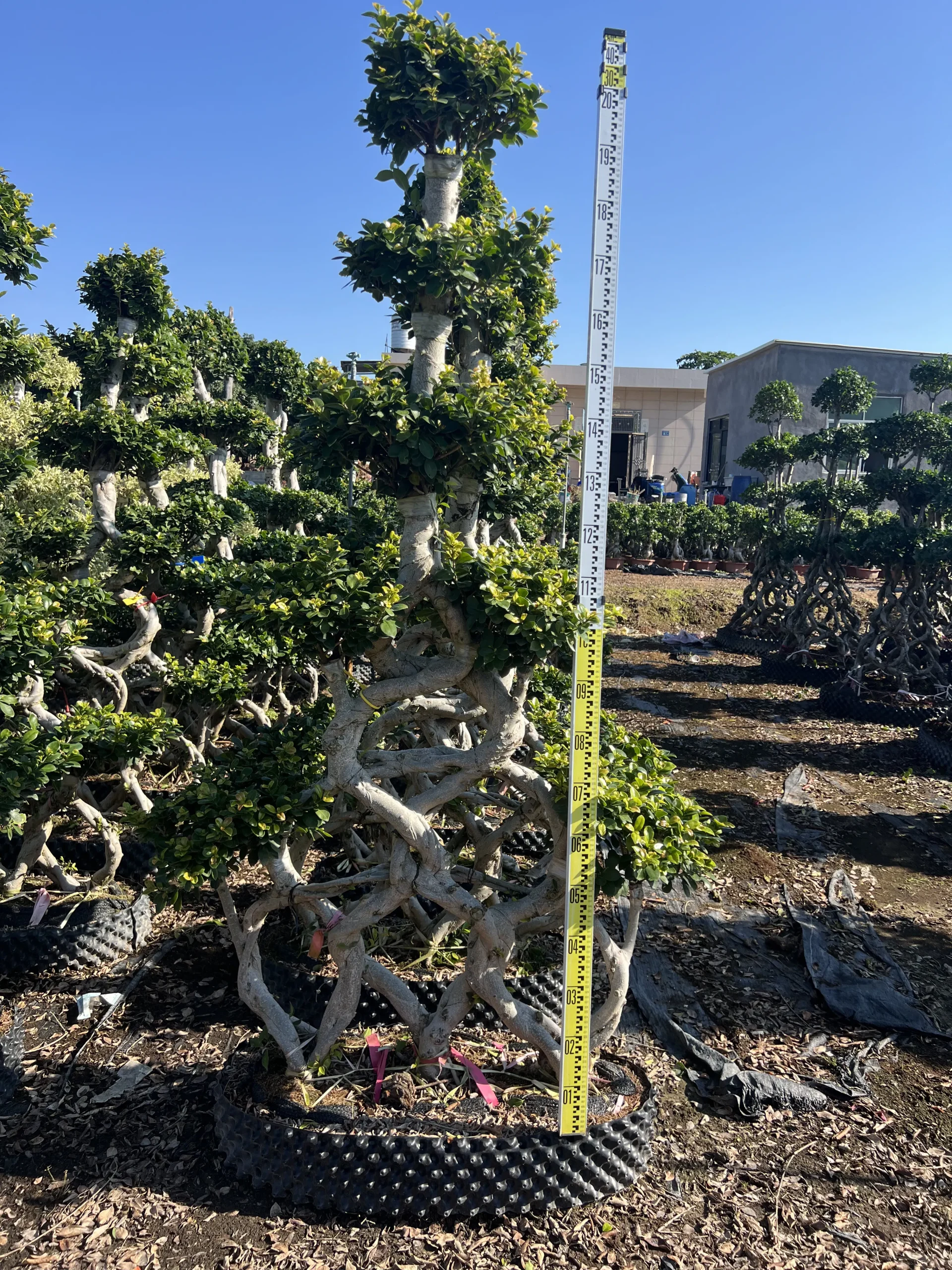
(1) Sculptural Structure Designed for Direct Use
Unlike standard banyan trees, this variety is pre-shaped into a symmetrical “8” double-trunk form. In ficus microcarpa bonsai care, this means significantly less post-purchase training is required. Buyers can use the plant directly in landscaping projects without additional shaping, saving both time and labor.
(2) Outdoor Cultivation Improves Survival Rate
A critical advantage in ficus microcarpa bonsai care is its cultivation method. After being sourced from Thailand, the trees are grown outdoors in Zhangzhou, where they are exposed to natural sunlight and wind. This process strengthens the root system and results in a transplant survival rate of over 95%.
(3) Stable Supply with Consistent Quality
A key advantage of ficus microcarpa bonsai care is its reliable, high-quality production cycle. With a dedicated team of experienced horticulturists and a streamlined process, plants are cultivated with precision, ensuring consistency across batches. Wulala Garden manages 8 nurseries with 112 experienced horticulturists, ensuring a continuous and standardized production process

2. Light and Temperature Needs of 8-Shaped Thai Ficus Microcarpa Bonsai Care
(1) Why Full Sunlight Is Essential
According to Wulala Garden horticulturists, light exposure directly determines the structural quality of this plant. In ficus microcarpa bonsai care:
- At least 6 hours of direct sunlight per day is required
- Insufficient light leads to loose structure and reduced canopy density
- Strong sunlight promotes compact growth and thicker trunks
This is why their experts consistently recommend open-field planting for commercial cultivation.
(2) Temperature Adaptability in Different Environments
Based on field experience from Wulala Garden experts:
- Optimal growth: 18°C–35°C
- Short-term tolerance: down to 5°C
- Protective covering is needed in prolonged cold conditions
This adaptability is a key reason why ficus microcarpa bonsai care remains efficient across different climates.
3. Watering Strategy for 8-Shaped Ficus Microcarpa Bonsai Care
(1) Managing Water During the Transplant Stage
Wulala Garden specialists emphasize that the first month is critical in ficus microcarpa bonsai care:
- Water every 2–3 days to maintain stable soil moisture
- Avoid water accumulation, which can suffocate roots
- Ensure proper drainage to support root respiration
This stage determines how well the plant establishes itself.
(2) Adjusting Irrigation After Establishment
Once new leaves appear, Wulala Garden experts recommend adjusting irrigation:
- Summer: once per week
- Spring and autumn: once every two weeks
- Winter: minimal watering, only when the soil surface is dry
This approach balances plant health with efficient water use.
4. Nutrient Management for Thai Ficus Microcarpa Bonsai Care
1) Building a Strong Nutrient Base
Before planting, ficus microcarpa bonsai care should include soil preparation:
- Add 1–2 kg of organic compost or decomposed manure
- Improve soil fertility and microbial activity
- Support early root development
2) Ongoing Fertilization for Growth Performance
Their experts further recommend:
- Applying slow-release fertilizer (N-P-K 10-10-10) every 3 months
- Using around 500 g per tree
- Promoting trunk thickening and canopy expansion
Consistent feeding ensures uniform plant quality across batches.
5. Pruning and Maintenance of 8-Shaped Ficus Microcarpa Bonsai Care
1) Minimal Pruning Requirements
- Only 2–3 pruning sessions per year are needed
- Focus on maintaining the existing “8-shaped” structure
- Remove irregular or excess branches
This greatly reduces long-term labor input.
2) Low Pest Risk and Easy Management
- Strong natural resistance
- Only 1–2 preventive treatments are needed annually
- Clean planting environments reduce risks
This makes ficus microcarpa bonsai care highly cost-efficient.
6. Commercial Value of 8-Shaped Double-Floating Thai Ficus Microcarpa
1. Faster Growth and Turnover
This variety demonstrates strong growth performance:
- Annual growth reaches 30–45 cm
- Plants become market-ready within 18–24 months
This enables faster turnover and higher productivity.
2. Higher Profit Margins
Their market feedback shows:
- Sales speed is 2–3 times faster
- Resale value increases by 20–30%
This explains the strong demand in commercial landscaping.
3. Ready-to-Use Advantage for Buyers
- No additional shaping is required after purchase
- Plants can be used immediately in projects
- This improves efficiency for contractors and developers
Conclusion
Effective ficus microcarpa bonsai care goes beyond basic maintenance—it requires an understanding of the plant’s structure, growth behavior, and commercial application. The 8-shaped double-floating Thai Ficus microcarpa, supported by Wulala Garden’s professional cultivation system, combines aesthetic value with practical advantages such as a high survival rate, low maintenance, and strong profitability.
By applying these targeted care strategies, growers and buyers can not only ensure plant health but also maximize long-term economic returns.